

Biomethane:​ From CO2 reduction to supply, key questions answered

Industrial companies face growing pressure to reduce greenhouse gas emissions while maintaining reliable energy supplies for production processes. Biomethane offers a scalable, renewable alternative to natural gas for process heat, continuous manufacturing operations, drying applications, and combined heat and power (CHP) generation.

How much CO₂ can biomethane help reduce?

The actual reduction in CO2 emissions depends on the proportion of biomethane used to replace natural gas. Under the Greenhouse Gas Protocol, biomethane is currently assigned a CO2 emission factor of zero in Scope 1 emissions (direct greenhouse gas emissions from a company’s own operations, such as production facilities) and Scope 2 emissions (indirect emissions associated with purchased energy), provided the relevant accounting and documentation requirements are met.

For energy-intensive industries in particular, where a significant share of energy-related CO2 emissions is generated, replacing natural gas with biomethane can offer considerable potential for reducing greenhouse gas emissions.

Scope 3 emissions cover indirect greenhouse gas emissions associated with a company’s activities, such as products and services. In this category, the remaining emissions linked to biomethane are taken into account. These emissions may result from feedstock production, transportation, and other stages of the supply chain.

As a result, the origin of the gas, transport routes, production process, and feedstock used all play an important role in determining the overall greenhouse gas footprint.

Biomethane in the greenhouse gas balance

What is included Approach to biomethane What that means

Scope 1

Direct emissions, e.g., from production facilities
Emissions value 0
The greatest potential for improvement lies in energy-intensive process heat
Scope 2
Emissions from purchased energy
Emissions value 0
Applies to purchased heat/electricity
Scope 3
Upstream Chain, Products, Services
Residual emission value
Depending on the substrate, origin, and route of transport

The reporting follows the current interpretation of the Greenhouse Gas Protocol. As of August 2026

How does biomethane supply work?

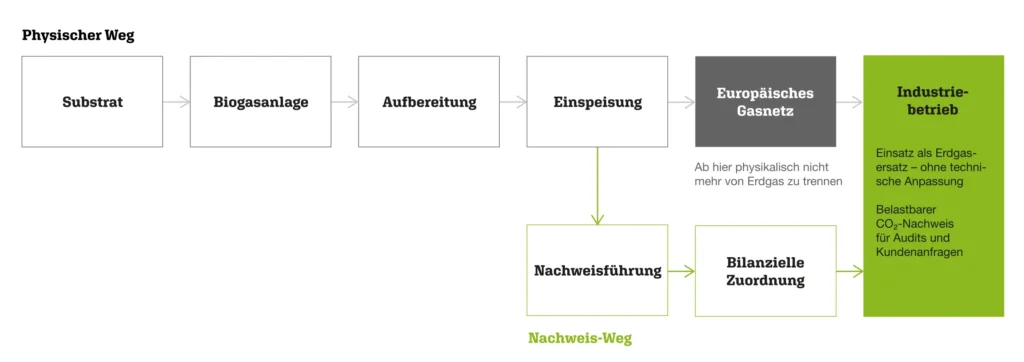
When companies choose a full biomethane supply or a partial biomethane blend, the biomethane is injected into the European gas grid and transported through the existing gas infrastructure. There are no technical modifications required. Once biomethane enters the gas grid, it can no longer be physically distinguished from natural gas. Instead, the biomethane share used by a company is allocated through a mass balance system.

Two ways, one molecule

How Biomethane Reaches Industrial Facilities—Physically and in Terms of Energy Balance

The physical path and the detection path diverge at the feed-in point—and converge again at the industrial facility.

Verification that the declared biomethane consumption corresponds to an equivalent amount of biomethane injected into the European gas grid is provided through mass balance systems such as the German Biogas Register operated by dena and/or recognised certification schemes including ISCC, SURE, and REDcert.

In addition to verifying the allocated biomethane volumes, these systems document the origin of the biomass, the production pathway, and relevant sustainability characteristics. This provides reliable evidence of greenhouse gas reductions throughout the supply chain, whether for audits, reporting requirements, or customer requests.

Is every quality of biomethane suitable for every application?

Biomethane is not always the same. Different feedstocks and production processes result in different biomethane qualities. These qualities can vary in their greenhouse gas reduction values and therefore in their contribution to emission reduction targets.

In addition, certain biomethane qualities may qualify for recognition under German (BEHG/EU ETS 2) and the European Emissions Trading System (EU ETS 1), depending on the applicable regulatory requirements.

How quickly can biomethane be supplied?

Suppliers such as bmp greengas offer a broad portfolio of biomethane qualities, enabling them to respond quickly to a wide range of customer requirements. This allows new demands, changing targets, and short-term requirements to be addressed efficiently. In many cases, lead times for customers are therefore relatively short.

A broad biomethane portfolio also provides greater flexibility. Depending on the contractual framework and availability, flexibility ranges of approximately 10% to 20% can often be agreed.

Implementation may take longer if biomethane is intended for recognition under EU ETS 1 (TEHG) or the German emissions trading system (BEHG). In such cases, certification of the installation may be required.

Companies considering biomethane benefit from early planning and coordination. This allows necessary steps to be prepared in advance and helps ensure an efficient implementation process. With the right planning and support, biomethane supply can be introduced smoothly and efficiently when needed.

What if my company already has a natural gas supply contract?

In many cases, the transition to biomethane can take place gradually through blending arrangements. In coordination with the existing energy supplier, biomethane can often be integrated into existing gas supply contracts through balancing group structures.

This can be achieved by blending biomethane into the existing gas supply, for example through a Virtual Trading Point (VTP) or SWAP delivery model.

How it works:

  • Biomethane volumes are allocated through balancing groups together with the corresponding sustainability and origin documentation.
  • For example, a customer may receive 30% biomethane from bmp greengas and 70% natural gas from their existing gas supplier.

Existing contractual obligations with the natural gas supplier can generally continue unchanged.

The experts at bmp greengas are happy to help you find the biomethane solution that best meets your company's operational, sustainability, and compliance requirements.

Kontakt

Die über die als Pflichtfeld gekennzeichneten personenbezogenen Daten verarbeiten wir – die bmp greengas GmbH – zum Zwecke der Beantwortung Ihrer Anfrage. Rechtsgrundlage ist insoweit Art. 6 Abs. 1 S. 1 lit. b DSGVO. Weitere Informationen zu unserem Umgang mit Ihren personenbezogenen Daten, insbesondere zu Ihren Rechten als betroffene Person und Ihrem Beschwerderecht bei der zuständigen Datenschutzbehörde und unsere Kontaktdaten finden Sie in unseren Datenschutzinformationen.